
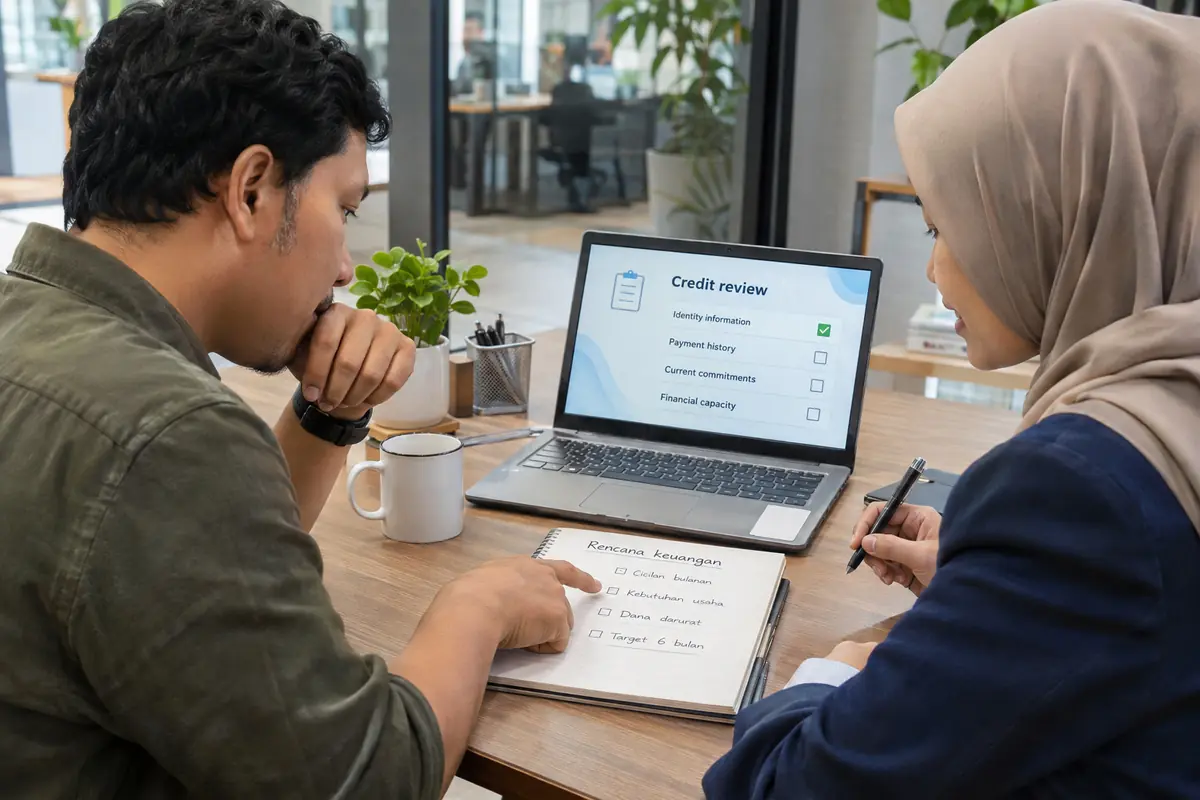
In Indonesia, a loan with bad credit history is credit extended to someone whose record in the national credit register shows late or unpaid installments, usually graded as collectibility level three to five. Banks often decline such applicants or limit the amount, so borrowers turn to collateral-based lending, guaranteed or group financing, and licensed platforms that weigh other evidence of ability to pay. The category also covers applicants with a settled past default who want to borrow again. Approval is never guaranteed, and a higher cost should be expected.
How a credit record is built and read
Every bank, financing company and licensed online lender reports to the Financial Information Services System (SLIK), run by OJK and the successor of the older BI Checking. The report lists each loan, credit card limit and installment, together with a quality grade from one to five: current, special mention, substandard, doubtful and loss.
Grades one and two are generally acceptable to lenders. Grades three to five are treated as non-performing and make approval at banks difficult until the account is settled. A single late payment of a few days normally does not damage the score for long, but arrears of several months do.
Applicants can request their own report through the OJK iDebku service before applying. Seeing the details avoids surprises, and it also reveals errors such as a closed loan still shown as active, which can be corrected through the reporting institution.
Why applications get declined
Lenders weigh three things: willingness to pay, ability to pay and security. A bad record points to weak willingness, so the rest of the file has to compensate. Common causes of refusal are overdue credit card bills, an unpaid online installment loan, a business loan that went into default, and many recent applications at different institutions.
Other points matter as well. A debt-to-income ratio that is already high, a short working history and mismatched personal data lead to decline even without a negative score. Knowing the exact reason lets the applicant fix it rather than apply repeatedly, since each hard inquiry is recorded and may weaken the profile.
When refused, ask the institution for the reason in writing or by phone. Many give only a general answer, but even that tells whether to repair the record first or to look at a different type of product.
Employment status also plays a role. Contract workers and freelancers may be asked for longer bank statements than permanent employees, and applicants who recently changed jobs sometimes face a waiting period before a lender accepts their income.
Options that may still be open
Collateral-based credit is the most direct path. Pawn services accept gold, vehicles or electronics, and the amount depends on the appraised value of the item instead of the borrower's past. State-owned pawn operators and licensed private pawn businesses operate under OJK supervision and return the item once the loan is repaid.
Other possibilities are secured loans backed by a vehicle or property deed, financing with a guarantor who has a clean record, and group-based microfinance for small enterprises, where the group shares responsibility. Cooperatives that know the member personally sometimes lend small sums as well.
Licensed peer-to-peer platforms may approve small amounts with high rates and short terms, and these should be treated with caution. A borrower who needs a larger sum but has an unresolved arrears should first negotiate with the original lender, since a settled account improves the grade in time.
Whatever route is chosen, the amount should match a real need. Borrowing more than necessary against an item or a guarantor raises the cost and the risk if income falls.
What it costs
Borrowing with a damaged record almost always costs more. Rates, administration fees and insurance are higher, and tenors are shorter. Online lenders in particular must follow the cost ceilings set by the industry authority, which has also limited the total amount that late fees may reach, yet the monthly figure can still be heavy for a small loan.
Compare offers on the total amount repaid, not on the monthly installment. Ask for the effective annual cost, the provision fee, the penalty schedule and the collateral appraisal fee. A pawn loan is usually cheaper than an unsecured online loan when the item is valuable, but the borrower risks losing the item if the payment is missed.
If a quote looks surprisingly cheap for a risky profile, check whether the advertised figure is a flat rate on the original principal, which is much costlier than it appears.
Insurance deserves a separate look. Credit life cover can protect a family from an unpaid balance, but it should be priced openly and not bundled silently into the installment.
Repairing the record
Credit repair is slow but possible. Settle overdue accounts first, since a loan marked as paid is judged better than an open default. Ask for a settlement letter, then check that the reporting institution has updated the register.
After that, rebuild trust with small obligations paid exactly on time: a modest credit card, a small installment or a savings-backed facility. Automatic debit prevents accidental delay. Keep the credit card balance well within the limit and avoid applying to many lenders within a short period.
Records of repaid arrears remain visible for some time, so time is part of the process. Many applicants return to normal bank eligibility after a period of regular payments and a healthy income history. Be wary of any service that promises to erase negative records for a fee, because the data can only be changed through the institution that reported it.
Warning signs and consumer rights
People with a poor record are prime targets for fraud. Illegal online lenders advertise approval without checks, request an advance fee, ask for access to contacts and photos, and threaten borrowers who are late. A licensed provider is listed on the OJK register, discloses all costs and handles collection within the law.
Never pay a fee to receive a loan. Never share the one-time code sent to your phone. Verify the company name, the app and the contact details against the official list before sending documents.
Consumers have the right to clear information, personal data protection and respectful collection. Complaints can be directed to the provider and then to OJK through contact number 157. Reports about illegal lending go to the multi-agency task force for illegal financial activity, which can also help block the app.
Keep records of every message and call received from a collector. Screenshots and dates make a complaint much easier to process and show whether the behavior crossed the line.
Frequently asked questions
Can I get a loan in Indonesia if my SLIK grade is poor?
Sometimes, but options narrow. Collateral-based loans, secured credit with a guarantor and small microfinance facilities are more realistic than an unsecured bank loan, and the cost will be higher.
How long does a negative record stay visible?
Settled accounts keep appearing in the report for a period, while the grade improves once the debt is paid and later installments are made on time. The exact duration depends on the reporting rules.
Is it possible to delete a bad record by paying a service?
No. Only the institution that reported the data can correct it, and any firm promising deletion for a fee should be avoided.
Do pawn loans require a credit check?
Pawn services mainly assess the value of the item, so the borrower's past matters less. The item can be sold if the loan is not repaid, so the risk is real.
Where can I complain about abusive collection?
Contact the lender first, then OJK on 157. If the lender is unlicensed, report it to the task force that handles illegal financial activity.
Further reading
- Pegadaian (Indonesian-language page; no English version found) : State-owned pawn operator offering gadai loans against valuables, with an online simulation and the TRING app.