
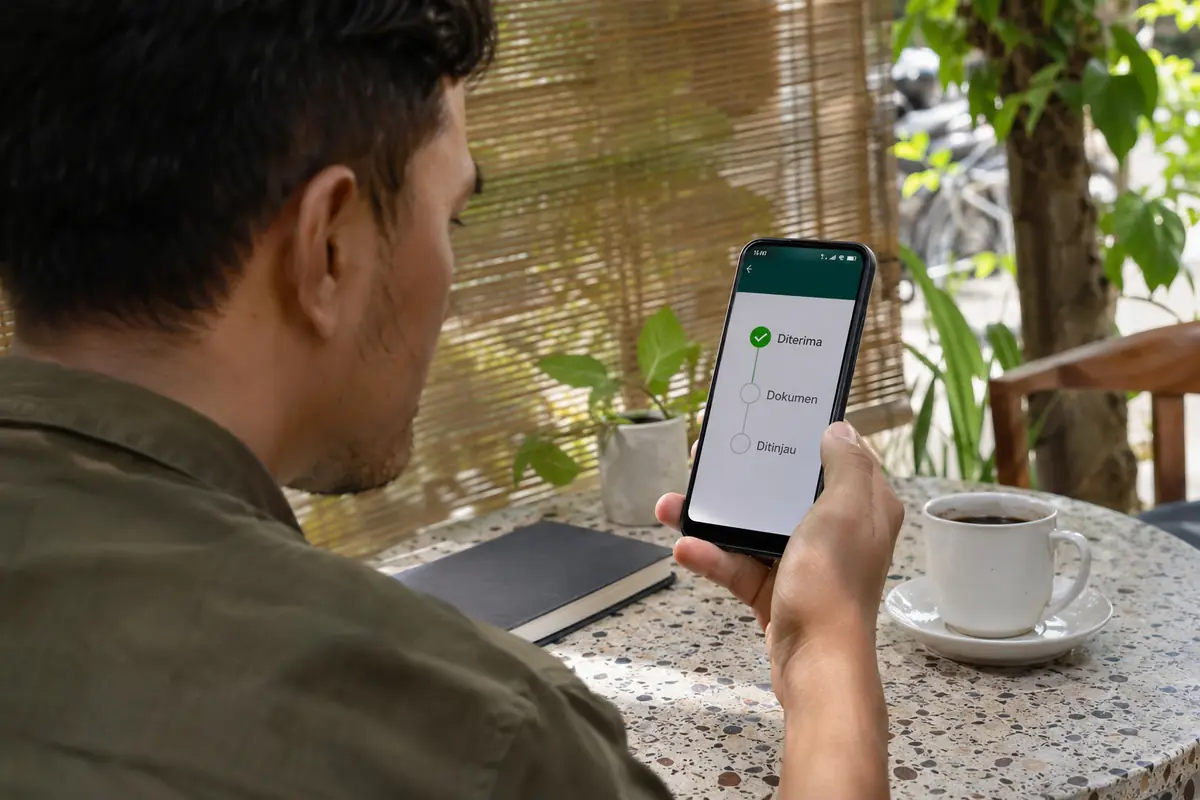
In Indonesia, the loan app application approval process is the sequence a lender follows after a borrower submits a request through its app: identity verification, data and credit checks, a decision on the amount and terms, acceptance of the agreement and finally disbursement. Licensed lenders must judge whether the applicant can repay, so approval is never automatic. Salaried employees, traders, freelancers and small business owners all pass through the same stages, though the documents and the speed differ with the product and the lender.
Stage one: submission and identity verification
The process begins when the borrower enters the amount, tenor and personal details and sends the request. The first filter is identity. The lender compares the national identity number, the card photo and a live selfie, and may confirm that the phone number belongs to the applicant. A mismatch of names, an unclear photo or a number registered to someone else stops the application at this point.
For this reason, details must be entered exactly as shown on the identity card, including spelling and address. Many rejections that look mysterious are simple data errors. Applicants who keep their card details, tax number and employer information at hand complete this stage in minutes.
Stage two: data checks and credit history
Once identity is confirmed, the lender examines the financial picture. Banks and many financing companies consult the credit information system run by the Otoritas Jasa Keuangan (OJK), known as SLIK, which shows existing loans, instalments and any arrears. Fintech lenders use that data, their own records and sometimes alternative information the borrower has agreed to share.
The quality of that history shapes the offer. A record of on-time payments supports a larger amount or a longer tenor, while overdue instalments reduce both or lead to refusal. A person with no history at all, such as a young worker, is not automatically refused, but the lender may start with a small limit and increase it after repayments are made on time.
Stage three: assessing the ability to repay
Lenders measure how much of monthly income is already committed to debts. A common sense rule is that total instalments should remain a limited share of income, and many institutions apply an internal ceiling. They also look at the stability of employment, the length of time in the current job, the type of contract and, for business owners, the regularity of sales.
Banks traditionally describe this analysis through the idea of character, capacity, capital, collateral and conditions. Even when the lender does not use those words, the questions are similar: is the applicant reliable, can the instalment be paid, is there savings or security, and is the purpose reasonable? Honest answers help, because inconsistencies between declared and documented income are a frequent reason for refusal.
Stage four: the decision and the offer
The decision may come within minutes for small amounts handled by automated systems, or after several days when a human analyst reviews the file or a survey is required. Mortgages and vehicle loans take longer because the property or vehicle must be valued and the legal documents verified.
If approved, the lender presents an offer with the amount, tenor, interest or margin, fees and the schedule. The offer may be lower than the requested amount. Read it as a proposal, not as an obligation: the borrower can decline, ask questions or compare it with another lender. Any pressure to accept within minutes or to borrow more than needed should be treated as a warning.
Stage five: agreement and disbursement
Acceptance happens electronically, usually with a code sent to the registered phone, and creates a binding contract. At this point the borrower should check the name of the lender, the total repayable, the due dates, the penalty for lateness and the conditions for early settlement. A copy of the agreement should be saved.
Disbursement follows, normally into a bank account or e-wallet in the borrower's own name. The time varies from minutes to a few working days. The first instalment date is then fixed, and setting a reminder prevents a late payment that would harm the credit record from the very start.
Why applications are rejected
Common reasons include inconsistent identity data, a poor credit record, income that is too low for the requested amount, too many recent applications, an unstable employment situation and incomplete documents. For fintech platforms, the lender's own risk model may also cap the amount for new customers.
A refusal is not a final judgement. The borrower can ask which area needs improvement, correct mistakes in the data and reapply after the problem is solved. Repeating the same request many times in a short period seldom helps and can leave a trail of inquiries that makes lenders more cautious.
Improving the chances of approval
Preparation matters more than persuasion. Check your own credit record, settle small overdue balances, and avoid new debts shortly before applying. Request a realistic amount that fits the budget, since an ambitious request raises the repayment burden and the risk of refusal.
Documents should be consistent: the same name, address and employer across the card, the payslip and the bank statement. Stable income deposited regularly into one account is easier to verify. If a co-applicant or guarantor is allowed, discuss the responsibilities openly with that person beforehand.
- Enter details exactly as printed on the identity card.
- Keep instalments within a comfortable share of monthly income.
- Apply to a few suitable lenders, not to all of them.
- Avoid any lender that guarantees approval.
Rights, transparency and complaints
Borrowers are entitled to clear information about costs and conditions before they agree, to protection of personal data and to fair collection practices. A lender may not use threats, humiliate the borrower or contact people unrelated to the loan. Promises of guaranteed approval without any assessment are inconsistent with responsible lending.
If the process raises concerns, begin with the lender's customer service and keep the reference number. Unsolved issues can be taken to the OJK consumer service on 157. For suspected unlicensed lenders, the same channel handles reports, and the borrower should stop sharing documents with them immediately.
Frequently asked questions
How long does approval take?
It ranges from minutes for small amounts handled automatically to several days for larger credit that needs analysis, a survey or document checks.
Is approval guaranteed if I submit all documents?
No. Complete documents allow the lender to assess the file, but the decision depends on credit history, income, debts and the lender's own criteria.
Will a rejection affect my credit record?
A refusal does not itself record a default, but a lender's inquiry and any overdue loans may appear in the credit system. Many applications in a short time can make lenders cautious.
Can the approved amount be lower than the requested amount?
Yes. Lenders often approve a smaller limit, especially for new customers, and the borrower is free to accept, negotiate or decline.
What should I do if a lender promises approval without checks?
Treat it as a warning, avoid sharing documents and verify the company in the OJK lists. Report suspicious offers to OJK on 157.
Further reading
- Amartha (English), financing and group loans for small businesses : Amartha explains its group loans for micro entrepreneurs, its investment products and the AmarthaFin app that gives access to them.