
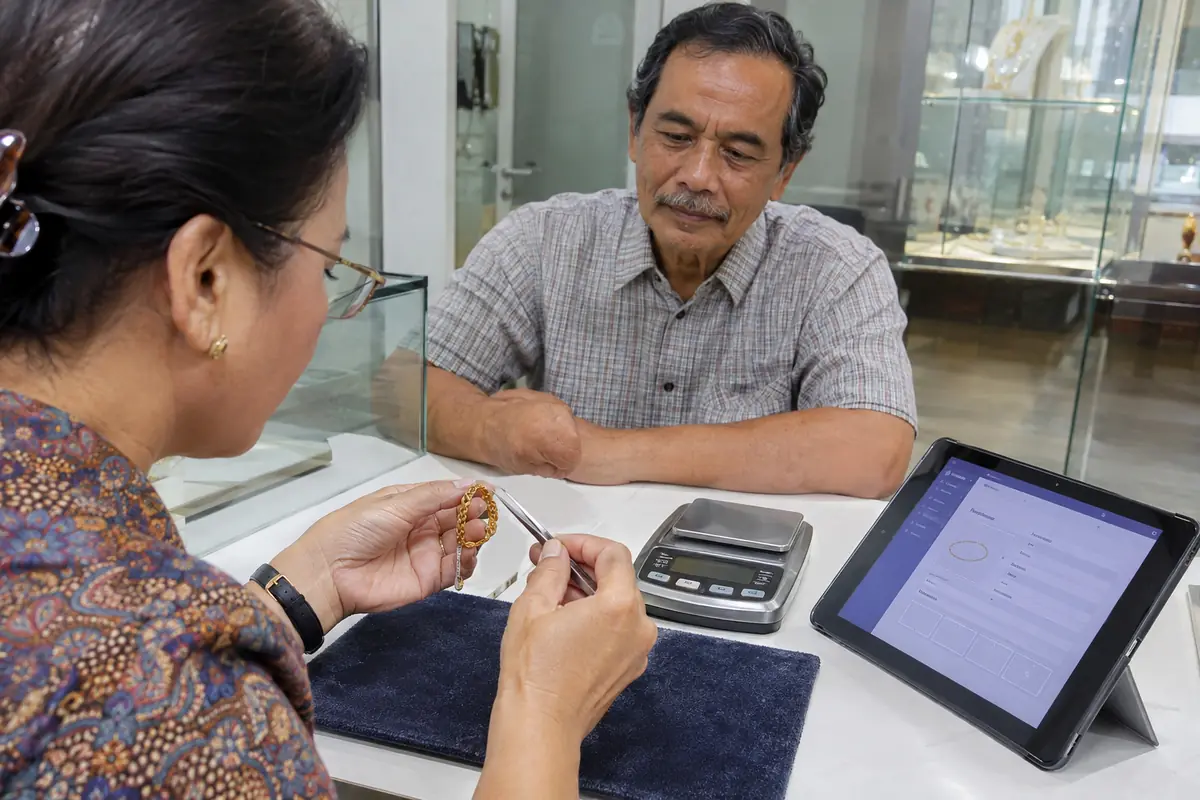
In Indonesia, a pawnshop loan is collateral based financing in which a borrower leaves a valuable item, most often gold jewellery, with a licensed pawnbroker and receives cash worth part of its appraised value. The item stays in storage until the borrower repays the principal and the agreed rental charge within the term. No salary slip or credit history is needed, which makes the product popular with traders, farmers and households facing sudden expenses. If the loan is not settled, the pledged goods may be sold at auction.
How gadai works from appraisal to redemption
The process is short. The borrower brings an identity card and the item to a pawn outlet. An appraiser tests the item, determines its value and offers a loan that is a share of that value. If the borrower agrees, a pawn contract is signed, the cash is paid out, and the item is stored in a vault.
The contract states the loan amount, the term, the fee structure and the date by which the loan must be repaid or extended. At the end of the term the borrower can redeem the item by paying the principal plus charges, or pay only the charges and renew for another period where this is allowed.
If the borrower does nothing, the lender is entitled to sell the item at auction once the grace period has ended. Proceeds first cover the principal and charges, and any surplus belongs to the borrower. That surplus can be claimed, so keeping the receipt and the contract is worthwhile.
Because the lender holds an asset, the decision does not depend on the borrower's pay or credit file. The loan amount depends on the item.
Items accepted as collateral
Gold is the benchmark collateral. Jewellery, bars and coins can be appraised on weight and purity, and their value follows the gold market, which makes the loan amount easy to predict. Diamonds and other gemstones are accepted at some outlets after certification.
Electronics such as phones, laptops and cameras are taken by many pawn businesses, though their value falls quickly with age and model changes, so the offered amount is lower relative to the original price.
Vehicles are a separate category. Depending on the product, the vehicle registration papers may be held as security while the borrower continues to use the vehicle, or the item may be kept by the lender. The contract must state which applies, because the consequences of default differ.
Goods that are stolen, disputed or of uncertain ownership are refused. Anyone who pledges an item must be able to prove that it belongs to them, and receipts or certificates help the appraiser.
Pawn providers and how they are supervised
The best-known provider is the state-owned company Pegadaian, which runs outlets across the archipelago and offers both conventional and sharia pawn products. Banks and licensed private pawn companies also provide the service in some regions, and several cooperatives offer pledge-based loans to members.
Pawn business is regulated by the Financial Services Authority (OJK), which licenses companies, sets rules on appraisal, storage, auction and reporting, and receives complaints. A licensed operator must show its permit and give a clear contract.
Unlicensed pawn operators exist, particularly in informal settings and online groups. They may charge hidden fees, hold items without proper insurance or auction them without notice. Before handing over valuables, a borrower should check that the business appears in the official register and has a physical place of business.
Sharia pawn, known as rahn, replaces interest with a storage and safekeeping fee and follows contract rules that the sharia supervisory board approves.
What a pawn loan costs
The fee on a conventional pawn loan is usually called a capital rental charge and is calculated on the loan amount for each fixed period. Providers also charge an administration fee at the start. For sharia pawn the charge is a safekeeping fee linked to the value of the item stored.
Because periods are short, borrowers sometimes underestimate the total cost. A useful habit is to ask for the full repayment figure for each possible repayment date and to compare it with a small bank loan or a licensed online loan.
Costs to compare include:
- The administration fee at signing
- The rental or safekeeping charge per period
- The cost of extension, if the contract is renewed
- Penalty or auction-related charges after the due date
Pawn loans are cheaper than many unlicensed apps and require no credit file, but they can become expensive if renewed again and again. A borrower who needs to extend several times should consider whether another form of credit fits better.
Who uses pawn loans and when they make sense
Traders use them to buy stock before a busy season, farmers to cover seed or fertiliser before harvest, and families to pay school fees or hospital bills. The speed is the main attraction: a transaction can be completed in a short visit.
Pawn credit suits short-term, predictable needs where the borrower is sure of income soon. It is a poor fit for covering long-running deficits, since the item may be lost if the cycle repeats.
A gold-owning household can also treat pawn as a way to keep assets while borrowing, instead of selling jewellery at a low moment. If gold prices rise in the meantime, redeeming the item preserves that gain.
The same logic means that the borrower should never pledge an item that cannot be replaced, such as an heirloom, unless the repayment plan is solid. Sentimental value is not recovered at auction.
People with steady income may find a bank loan or a cooperative loan cheaper over a long tenor, and those with poor credit records may still prefer pawn because it does not depend on the file.
Risks, rights and good practice
The main risk is losing the item. Before signing, a borrower should read the due date, the grace period, the auction procedure and the way the lender will notify them.
Insurance and security of storage are the operator's responsibility. If a pledged item is lost or damaged in storage, the borrower has the right to compensation under the contract and consumer law.
Good practice includes photographing the item before handing it over, keeping the original receipt, never signing a blank form, and checking the weight and purity reading in front of the appraiser. Any discrepancy should be raised immediately.
For complaints, begin with the outlet manager and the provider's customer service. If the problem persists, OJK's consumer contact centre on 157 accepts complaints about licensed pawn companies, and the financial-sector dispute resolution body can mediate when the operator does not respond.
Frequently asked questions
Do I need a salary slip for a pawn loan in Indonesia?
No. The decision rests on the value of the item, so an identity card and the collateral are normally enough. Some products for larger amounts may ask for extra documents.
What happens if I cannot repay on time?
Many contracts allow renewal by paying the charges for another period. If neither repayment nor renewal happens before the grace period ends, the lender may auction the item, and any amount beyond the debt belongs to the borrower.
Which items can be pawned?
Gold jewellery and bars are the most common, followed by electronics and, with some products, vehicle documents. Items must be genuine, in good condition and owned by the borrower.
Is pawn financing allowed under sharia principles?
Yes, sharia pawn (rahn) exists and replaces interest with a safekeeping fee, under contracts approved by a sharia supervisory board.
How can I check whether a pawn business is legitimate?
Look for the operator in the OJK register of licensed pawn companies, confirm that it has a physical office and a written contract, and avoid anyone who asks for payment before assessing the item.
Further reading
- Pegadaian (Indonesian only, no English version found) : Official page of the state-owned pawn company, in Indonesian, covering pawn services, gold products and a branch locator.