
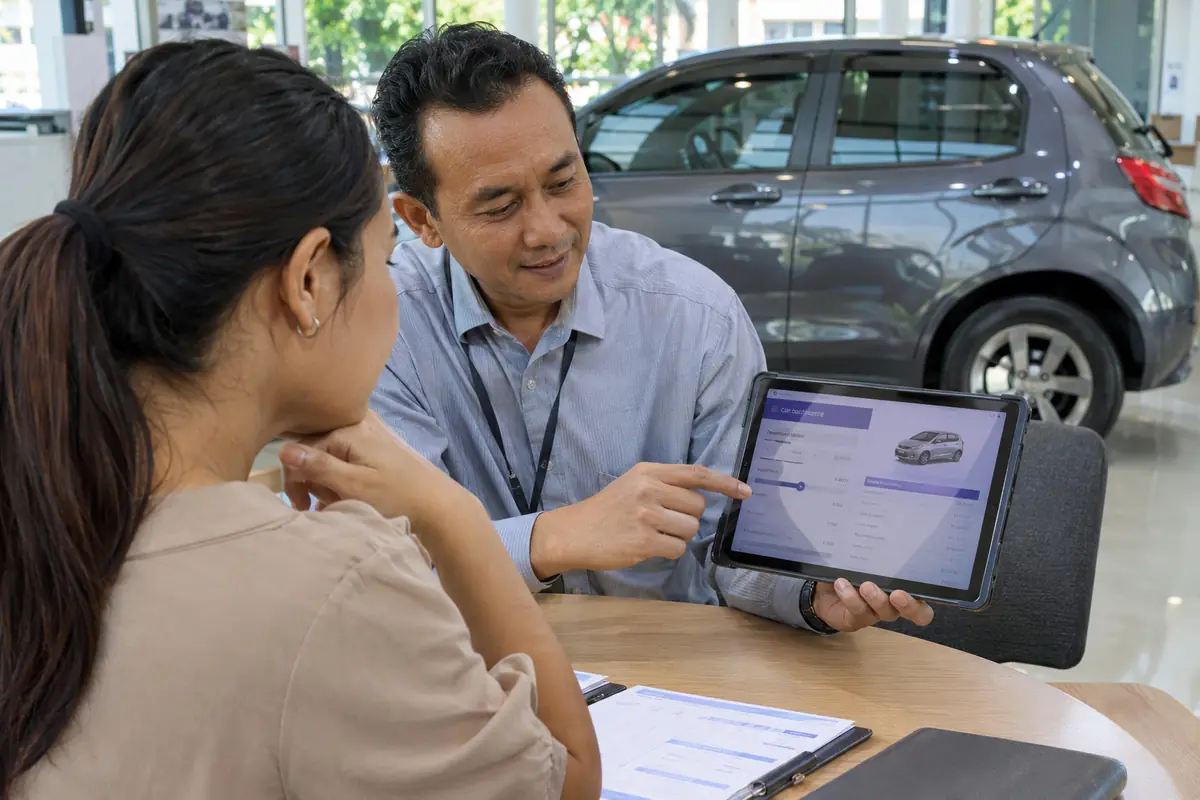
In Indonesia, a car loan is one of the most widely used vehicle financing options, letting a buyer take a new or second-hand car home while paying the price in monthly instalments. The lender pays the dealer, the buyer pays a down payment and the remaining balance is repaid over a set term, with the car itself acting as security. Both banks and multifinance companies provide this credit. It suits salaried workers, entrepreneurs and professionals who can show regular income and an acceptable credit record.
Where a car loan comes from
Two families of lenders dominate. Banks offer kredit kendaraan bermotor, usually shortened to KKB, and tend to give lower rates to customers who already hold a salary account or a good transaction history with them. Multifinance companies, often linked to car brands or banking groups, specialise in vehicle credit and are known for quicker decisions and more flexible requirements, at a price that can be higher. Dealers act as the entry point for most buyers. A showroom will usually propose one or more partner lenders, and the promotion on display, such as a special rate or a subsidised first year, applies only to that partner. Buyers remain free to arrange financing independently and to compare it with the dealer offer before choosing. Alongside a standard loan, some lenders provide sharia-compliant vehicle financing based on a sale-and-resale contract, where the margin is fixed at signing instead of being charged as interest.
Down payment and how much can be financed
The down payment determines the loan amount, and therefore the instalment. Bank Indonesia sets macroprudential limits on how much of a vehicle's price banks may finance, and OJK sets comparable limits for multifinance companies. These limits have been loosened more than once to support vehicle sales, so some lenders advertise a very low or even zero down payment. In practice, the advertised figure is available only to applicants with a strong profile and sometimes only for certain models. A larger down payment still lowers the total interest, keeps the instalment lighter and leaves a safer margin if the car loses value quickly. Many buyers aim for a down payment that keeps the instalment within roughly one third of monthly income. Ask for the loan to be shown in two versions, one with the minimum down payment and one with a larger sum, and compare total repayment rather than the monthly figure alone.
Rates, fees and total cost
Car loans are most often quoted as a flat rate per year, which looks low because it is calculated on the original price for the whole term. The same loan expressed as an effective rate on the declining balance is considerably higher. Converting offers to one comparable yearly rate is the first step. Typical cost items include:
- A provision or administration fee, charged once at signing.
- Credit life insurance on the borrower.
- Vehicle insurance for the whole term, paid upfront or spread across instalments.
- A fiduciary registration fee, a notary or processing fee and an appraisal fee for used cars.
- Late fees per day and a fixed charge for early settlement.
Ask the lender for a complete schedule showing each fee, and make sure promotional offers do not hide charges inside the insurance premium.
Insurance on a financed car
Lenders require insurance because the car is the only security. Two forms are common. Total loss only, or TLO, pays out when the vehicle is stolen or destroyed beyond a set share of its value. Comprehensive or all-risk cover pays for damage of every size, including minor accidents, and costs more. Most contracts use a mix, with comprehensive cover in the early years and TLO later, since the car loses value as time passes. Rate tables depend on the vehicle category and the region of registration, with higher premiums in areas with more theft or flooding. Check what the policy excludes, who the beneficiary is and how claims are handled. A cheaper premium that rejects flood damage may cost far more than it saves in a city that floods each rainy season.
Fiduciary security and the vehicle papers
The car stays registered in the buyer's name, but the lender holds the BPKB, the ownership book, until the last instalment is paid. The security is created through a fiduciary deed registered under the fiduciary law, and the registration gives the lender a legal claim over the car if the borrower defaults. Borrowers should receive a copy of the fiduciary certificate and should never agree to arrangements where the car is handed over without proper registration or where only the STNK is retained. Such shortcuts weaken the buyer's position and have created legal disputes for both sides. After the final payment, the lender releases the BPKB, and the buyer should verify that the fiduciary record is deleted so the car can be sold or refinanced without trouble.
New cars, used cars and loan terms
New cars generally attract the lowest rates and longest terms, commonly up to five years. Used cars are financed at higher rates and shorter terms because older vehicles lose value faster and are harder to assess. Many lenders also limit the combined age of the car and the term, so that the car is not older than a set number of years when the loan ends. A used-car buyer should check the registration papers, the chassis and engine numbers, the tax payment record and the physical condition independently of the seller. A lender-approved appraisal protects the lender, not the buyer.
Late payments, repossession and early settlement
Missing a payment triggers a late fee and, after repeated delays, a worse credit grade in SLIK, which affects every later loan application. A lender cannot lawfully take a car by force when the borrower disputes the default. A Constitutional Court ruling requires either voluntary surrender or a court process for execution of fiduciary security in such cases. Borrowers in difficulty should negotiate before missing payments, asking for a longer term or a temporary adjustment. When funds become available, early settlement lowers the total interest, but check how the lender calculates the remaining interest and any penalty. Annual vehicle tax and STNK renewal remain the owner's duty throughout the loan.
Frequently asked questions
What is the difference between a bank car loan and multifinance financing?
A bank car loan, called KKB, usually has a lower rate but stricter income and account requirements. A multifinance company decides faster and accepts more profiles, but its effective cost is often higher, so compare both before signing.
Is zero down payment really possible for a car in Indonesia?
Rules for banks and multifinance companies allow very low or zero down payment for qualified buyers and selected vehicles. Each lender still applies its own risk assessment, so approval and the final rate depend on the applicant.
Who keeps the BPKB while the car loan is running?
The lender keeps the BPKB until the loan is fully repaid. The car stays in the buyer's name and the buyer can use it, but cannot sell it without the lender's consent.
Can I repay a car loan early?
Usually yes, though many contracts require a minimum number of instalments first and charge a penalty or recalculate the remaining interest. Request the exact formula in writing before making the payment.
What happens to the loan if the car is stolen or totally damaged?
The insurer pays according to the policy, normally to the lender first, and the settlement is applied to the outstanding balance. Any shortfall between the payout and the balance remains the borrower's responsibility.
Further reading
- BCA Vehicle Loan (KKB) : English-language page of a major Indonesian bank presenting its vehicle loan for buying or refinancing a car, with contact channels.