
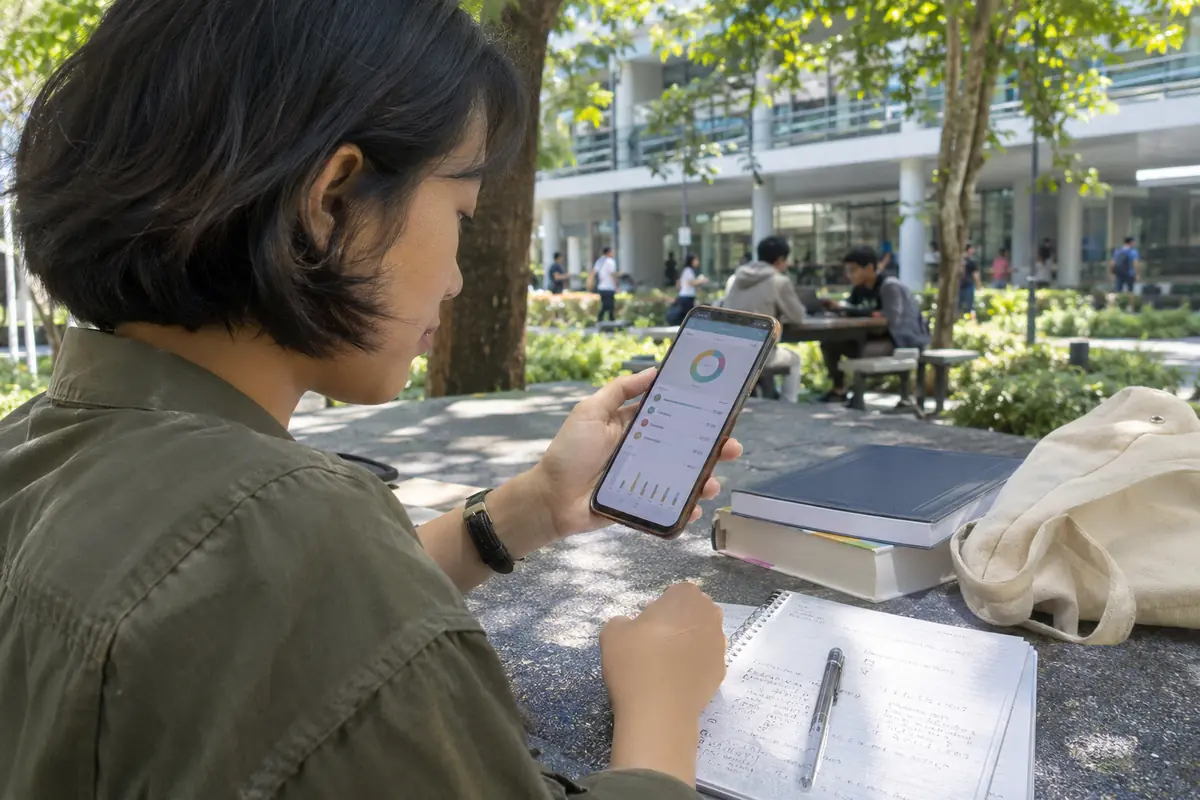
In Indonesia, a student loan for higher education financing is credit or an installment plan that pays tuition and related study costs, with repayment spread over months or years. It can cover single tuition fees (UKT), admission fees, housing, books and laptops at universities, polytechnics and institutes. Borrowers are usually students, parents or guardians who cannot pay a semester bill in one amount. Providers include banks, licensed financing companies and OJK-licensed online platforms, and every offer should be compared on total cost and repayment duration rather than on the monthly figure alone.
What a student loan pays for
Higher education in Indonesia costs more than tuition. A semester bill may combine the single tuition fee (UKT) at a public university, development or admission fees at a private campus, and a separate set of expenses for rent, food, transport, books and a laptop. Financing products differ in which of these items they accept, so the first question for any applicant is what the money may legally be spent on.
Some products are paid directly to the institution. In that case the borrower never touches the cash and the campus confirms the bill. Others are credit for general needs and land in a personal bank account. Direct payment is easier to track, while cash credit is more flexible but easier to misspend.
The level of study matters as well. Diploma, bachelor, master and doctoral programs, as well as professional courses and study abroad, are priced differently, and lenders usually set a maximum amount and tenor for each category.
Where the money comes from
There are four main routes. The first is a bank loan, normally secured by the parent's salary or a guarantee, because most students have no income of their own. The second is an installment plan arranged through a licensed online platform that specializes in education fees. The third is a campus arrangement, where the university lets families pay in stages without interest or with a small administrative charge. The fourth is a Sharia-based arrangement from an Islamic bank.
Online platforms that appear on the OJK register of licensed providers are the most visible alternative to banks. Some of them pay the institution directly and offer terms of several months up to about a year and a half, which suits tuition more than a multi-year degree.
Scholarships such as KIP Kuliah and LPDP are not loans and carry no repayment of the awarded amount, so they should be checked before any borrowing is considered.
Employers sometimes support the next generation of staff through study advances, and cooperatives offer small education loans to members. These sources are limited in size, but their cost is often lower than commercial credit.
Who qualifies and which documents are asked
Because a student is rarely a full earner, many lenders look at the person who will actually repay. That may be a parent, a spouse or a guarantor with a salary slip, a business license or bank statements. Lenders normally check age, residence, identity and the regular income of whoever is liable.
The usual document set includes:
- National ID (KTP) of the applicant and of the guarantor, plus the family card (KK)
- Proof of enrollment or an admission letter
- The tuition bill issued by the university
- Proof of income such as a salary slip, tax number (NPWP) or bank statements
- A selfie or video verification for online applications
A history of overdue payments in the credit register (SLIK) can reduce the chances or shorten the permitted tenor.
Comparing the true cost
A low monthly installment can hide a high total. Before signing, compare the annual percentage cost, the administration or provision fee, insurance, late-payment charges and any early-repayment penalty. Financing offered through installments often quotes a flat monthly rate, which is not comparable to a declining-balance rate, so ask for the full repayment schedule and the total amount payable.
A simple test is to divide the total repayment by the amount actually received. The gap between the two numbers is the real price of borrowing. Longer tenors reduce the monthly burden but increase the gap.
Islamic banks structure student financing as a sale or a lease rather than an interest-bearing loan. The margin is fixed in the contract, which makes the schedule predictable, yet the total should still be compared like any other offer.
Repayment, grace periods and life during studies
Repayment can start immediately, which is typical for fintech installment plans, or after a grace period, which some banks allow while the student is still enrolled. During a grace period interest or margin may continue to accumulate, so the balance at the first installment can be higher than the amount borrowed.
A household budget should include the installment next to the other fixed costs of study life. Many families plan so that the education installment stays within a modest share of monthly income, leaving room for emergencies. Autodebit from a salary account lowers the risk of a missed due date.
If income drops, contact the lender before a payment is missed. Restructuring or a rescheduled tenor is easier to negotiate before the account becomes overdue, and late records remain visible in the credit register for years.
Students who finish early or receive a bonus can ask whether extra payments reduce the remaining principal or only shorten the tenor, because contracts treat early settlement differently.
Risks and how to protect yourself
The biggest danger is borrowing from an unlicensed lender. Illegal online lending operators advertise fast student money, then charge hidden fees and misuse the contacts stored in the phone. A legitimate provider is registered with OJK, discloses the cost before the contract is accepted and does not demand access to the whole contact list.
Other risks come from borrowing more than the degree needs, relying on future part-time income that may not arrive, and signing a contract without reading the penalty clauses. Keep a copy of every agreement and payment receipt.
For a complaint about a financial institution, the consumer contact service of OJK can be reached at 157, and the phone number is also served through a WhatsApp line. Suspected illegal lenders can be reported to the multi-agency task force for illegal financial activity.
Frequently asked questions
Can a student in Indonesia take a loan without a parent as guarantor?
It is difficult, because most lenders need a steady income. Students with a part-time job or a scholarship stipend may qualify for small amounts, but larger tuition financing usually requires a parent or guarantor.
Is a scholarship better than a student loan?
A scholarship such as KIP Kuliah or LPDP does not have to be repaid, so it carries no financing cost. Loans are normally used to cover the part that a scholarship, savings or family support does not reach.
Does the loan go to the student or straight to the university?
It depends on the product. Education installment platforms usually pay the institution directly, while a bank personal loan is paid into the borrower's account and can be used freely.
How can I check whether an online education lender is legal?
Search the name on the OJK list of licensed providers, confirm the app and website match the registered entity, and avoid any offer that arrives through unsolicited messages.
What happens if an installment is missed?
Late charges apply, the delay is recorded in the credit register, and repeated delays can lead to collection and loss of access to future credit. Early contact with the lender allows a plan to be agreed.
Further reading
- Danacita (Indonesian-language page) : OJK-licensed education financing platform paying tuition and course fees to institutions in installments of 3 to 18 months; no English version was found.