
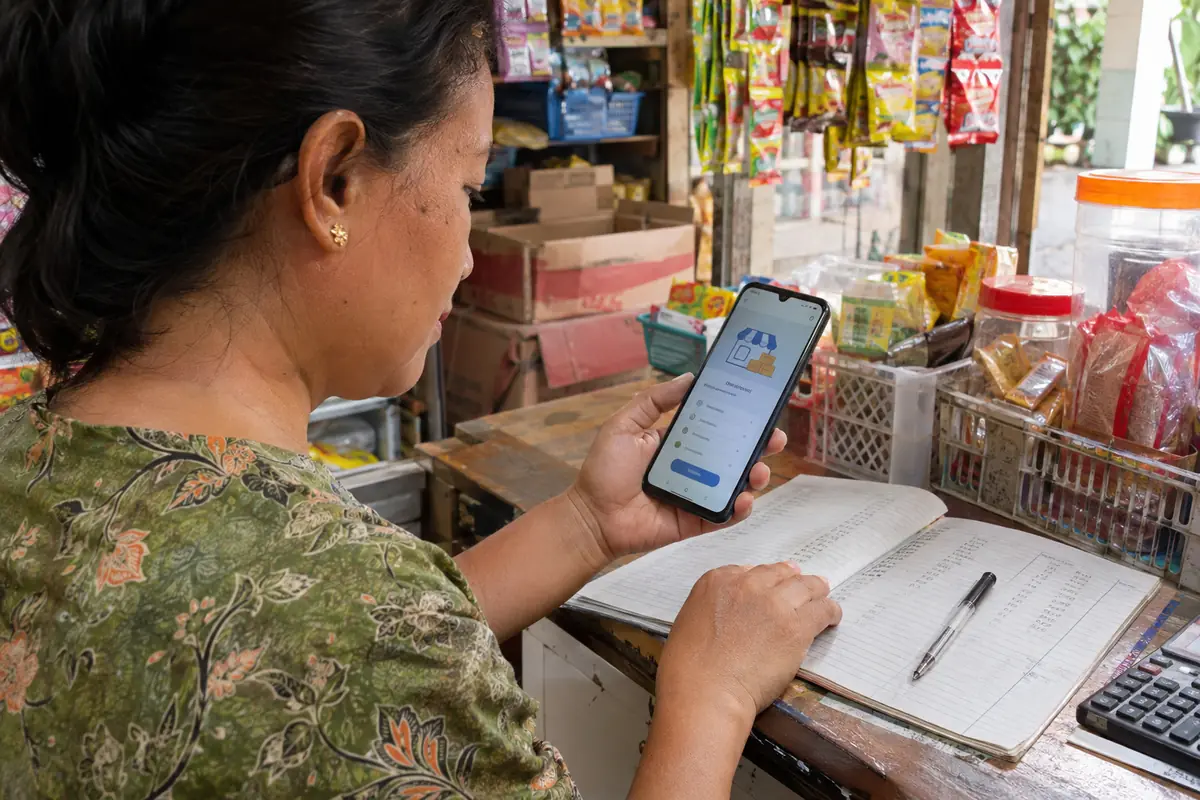
In Indonesia, microcredit for a small business takes the form of microfinance loans, usually under a few hundred million rupiah, made by rural banks, cooperatives and state programmes to street vendors, farmers, home producers and shopkeepers. Such borrowers often lack the collateral or accounts that a commercial bank wants. Repayment is typically weekly or monthly, and group guarantees sometimes replace property pledges. Microfinance loans can pay for stock, tools and a working vehicle, while savings and insurance products from the same providers help owners absorb shocks.
The microfinance landscape in Indonesia
Indonesia has one of the most developed microfinance systems among emerging economies, and its roots stretch back to village banks and savings groups. Today the sector is a mix of formal and semi-formal players.
Large commercial banks run dedicated micro units and reach traders in markets and villages through branches and field officers. Rural banks (BPR) and sharia rural banks (BPRS) serve district-level customers and are supervised by the Financial Services Authority (OJK), with deposits covered by the deposit insurer (LPS) within its limits.
Microfinance institutions (LKM) and savings and loan cooperatives lend to members in their communities. State-owned PNM, which focuses on women entrepreneurs and small firms, and Pegadaian, which lends against pawned goods, belong to the same government-linked family of ultra-micro lenders along with a major state bank.
Fintech platforms have joined the field, offering group loans and digital working capital to micro-merchants, subject to licensing by OJK. The result is a wide menu in which a small business owner can usually find more than one option within reach.
People's Business Credit and other state-backed programmes
The government runs the People's Business Credit scheme (KUR), a programme in which partner banks lend to micro and small businesses with an interest rate set by the government and a credit guarantee that reduces the lender's risk. Participating banks include the large state banks, regional development banks and some sharia banks.
KUR serves productive activity, meaning working capital or investment, rather than consumption. Borrowers generally need a business that has operated for some months, an identity card, a family card, a business permit in simple form (NIB or a village business certificate) and, for amounts beyond a small threshold, some collateral. For smaller amounts banks often rely on the business itself.
An ultra-micro financing programme complements KUR for very small enterprises through designated lenders and cooperatives, with a lower ceiling and lighter documentation.
Conditions, ceilings and rates for these schemes are changed by ministerial regulation from time to time, so the current figures should be confirmed with the bank or the coordinating ministry before applying.
Group lending and weekly repayment
Group-based lending works especially well for women running tiny home businesses. Members form a group of several borrowers who meet regularly, support each other and share responsibility. Without requiring land or property as security, the group's social pressure and the field officer's regular visits keep repayment rates healthy.
Loans start small, often just enough for one cycle of raw materials, and increase with each cycle that is repaid on time. A borrower who builds a record can move from group loans to individual bank credit.
Repayment is weekly or biweekly and collected at a meeting point, by transfer or through a wallet. The short cycle matches the income pattern of someone who sells daily, yet it means the cost is felt quickly if sales slow.
Many programmes bundle training in bookkeeping, pricing and savings, plus microinsurance covering death or illness. These extras are an important part of the product, not a decoration, because a family business is often fragile when one person falls sick.
Requirements and how to apply
Requirements depend on the lender and the size of the loan, but the pattern is consistent. Microlenders look at the character of the borrower, the cash flow of the business and a small amount of collateral.
- Identity card (KTP) and family card (KK)
- Proof that the business exists, such as a trading permit, photos of the stall, a village letter or sales notes
- Business history of at least several months
- A savings account at the lender, where one is demanded
- Collateral for larger amounts, such as a motorbike registration, land certificate or equipment
Application can start at a branch, with a field officer who visits the business, or through an application on a phone. Officers want to see the stock, the customers and the daily routine, so honest and tidy record-keeping, even in a notebook, gives an advantage.
Approval can take from a few days to a couple of weeks. Applicants should not pay anyone for a promise of faster approval, since licensed lenders do not charge for processing outside the published fees.
Costs and how to compare offers
Microloans are more expensive per rupiah than large corporate loans because the administration and field work are spread over small amounts. The goal is to compare costs transparently, not to look for the lowest advertised number.
Compare the effective annual rate, not the flat monthly rate. A flat rate calculated on the original amount looks smaller than a declining-balance rate with the same payments. Ask for the total repayment, the monthly or weekly instalment, and the fees for administration, insurance and early settlement.
Savings requirements matter. If a lender asks for compulsory savings or a deposit, the effective amount received is smaller than the nominal loan, and the cost increases.
Programmes with an interest subsidy, such as KUR, usually cost far less than market-priced microcredit, but they come with eligibility rules and an application process. A business that qualifies should check this route before turning to commercial microlenders or applications.
Choosing a trustworthy lender and avoiding traps
Licensed lenders show their permit, give a written agreement and publish costs. Rural banks and microfinance institutions are listed with OJK, and cooperatives are registered with the cooperatives ministry. A lender that cannot show its registration deserves caution.
Door-to-door lenders who charge daily or weekly interest without paperwork, often called rentenir, trap borrowers in expensive cycles. Their money is fast, but the real annual cost can be many times that of a regulated lender.
Digital offers that promise instant money without checks, demand access to a borrower's contacts or press for repayment through shaming are typical of unlicensed operators.
Before signing, read the amount, tenor, instalment size and penalty clause. Keep a copy of the contract and every payment receipt. If a dispute arises, the lender's complaint desk is the first step, followed by OJK's contact centre on 157.
Frequently asked questions
What is the difference between microcredit and microfinance?
Microcredit is the loan itself. Microfinance is the wider set of services for low-income people and small firms, including savings, insurance and payment services alongside loans.
Can a small business without collateral get a microloan in Indonesia?
Often yes, particularly for small amounts. Group guarantees, the business's own cash flow or programmes with a credit guarantee can replace property collateral, though larger loans usually require some security.
What is KUR and who can use it?
KUR is a government-backed loan scheme delivered through partner banks for productive micro and small businesses. Applicants need an operating business and basic documents, and the rate is set by the government.
Are microfinance loans safe from high interest?
Licensed lenders must disclose costs and follow regulation, so they are safer than informal moneylenders. Comparing the effective annual rate remains important.
Where do I complain if a microlender treats me unfairly?
Start with the lender's complaint channel, then contact OJK on 157. Cooperatives can also be reported to the cooperatives ministry.
Further reading
- PNM (Indonesian only, no English version found) : Official site of a state-owned microfinance provider, in Indonesian, describing Mekaar group loans for women and ULaMM micro-capital services.